
This site uses non-intrusive cookies to enable us to provide a better user experience for our visitors. No personal information is collected or stored from these cookies. The Society's policy is fully explained here. By continuing to use this site you are agreeing to the use of cookies.
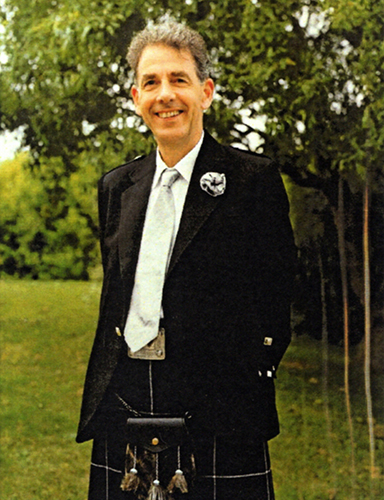
Alistair on the day of his marriage to Barbara
Alistair Wright was born on 20th November 1932 and brought up in Glasgow, Scotland, where he attended Mosspark Primary School from 1937-1944, followed by Allan Glen's School from 1944-1950. He progressed to the Royal Technical College of Glasgow, forerunner of the University of Strathclyde, where he qualified for the College Associateship (ARTC) in Mechanical Engineering with first class honours in 1954. Whilst studying, he undertook vacation training on the shop floor of the British Railways St Rollox Works and in the drawing office of the North British Locomotive Company at Springburn. He had intended to pursue a career in railway traction engineering, but the locomotive building industry in Glasgow was then in a state of decline and career prospects there were poor, so he opted instead for aerospace engineering starting with Rolls-Royce in Glasgow and then their Derby special project design office in 1956 where he worked as a designer on the Conway, the first of the (then revolutionary) multi-shaft by-pass aircraft engines. This appointment carried permanent deferment from National Service, which, to Alistair's disappointment, prevented him from taking up the opportunity of a flying commission in the Royal Air Force.
In 1959 he went to work for English Electric in Stafford, where he progressed to Chief Mechanical Designer (DC) in the Large Industrial Machines Division in 1961. The takeover of all the big electrical manufacturers in the UK by GEC in late 1968 prompted a change of career, as prospects of promotion had dwindled in the enlarged company. He was offered a senior design post in a new joint venture created by Alfred Herbert and the Ingersoll Milling Machine Co, making special purpose machine tools, mainly for the motorcar industry where he became a Project Manager before the company went into liquidation in 1972 in the wake of the Rolls-Royce debacle of 1971.
A complete change of industry followed, with Alistair joining Rank Xerox's new development laboratory as a photocopier research and design engineer in the summer of 1972 and then in 1974 into general management for seven years. Following a move back to mainstream engineering in 1981 he managed the team that introduced Computer Aided Design into the Rank Xerox design offices.
In 1983, Alistair returned to hands-on design management with an appointment as Chief Designer at Pilkington Perkin-Elmer, a company in the electro-optics business that mainly produced weapon sights for guns and tanks and moving map and head up displays for fighter aircraft. This was a time of great innovation in military electro-optics and Alistair led the introduction of Computer Aided Design to Pilkington Perkin-Elmer and its sister company, Barr and Stroud.
Alistair returned to Scotland in 1989 to work for Ferranti International (taken over later that year by GEC) as Principal Mechanical Designer on a joint US/UK programme in laser designated weapons. His intention in taking this post had been to return to 'hands-on' design engineering, but he was once again promoted and finished his career at GEC-Marconi in 1995, as a Chief Engineer on various programmes some of which are classified to this day.
Having been elected as a Member of the Institution of Mechanical Engineers in 1963, he received a certificate to mark 50 years of membership in 2013.
Outside of work, Alistair was interested in sailing, railways, model railways and music. He held the FAI 'Silver C' gliding badge and was a gliding instructor for ten years before retiring from active flying in 1978.
That's the official Alastair by Alastair and as supplied by him as biographical information to the University of Strathclyde in 2025 for their alumni website, lightly edited by myself.
Anyone interested in knowing more of Alistair's time at St Rollox or at NBL is referred to a pair of autobiographical articles which were published in the periodical Backtrack. The first dealing with St Rollox in 1951 can be found in the December 1996 edition while the NBL is dealt with in the January 1998 issue.
At a personal level, I first encountered Alistair in about 1985 during his time as the Historical Model Railway Society's Drawings Steward. I had received from him copies of the drawings they held for Caledonian Railway coaches built by Pickering of Wishaw and suggested that they might be good candidates for inclusion in his then expanding range of "5522 Models" photo-etched coach kits. His reply was "Why don't you do them?" When I said I wouldn't know where to start a collaboration was born where Alastair did the design and I did the rest under the "Caley Coaches" banner. He went on to mentor me such that I became proficient in kit design. I am not alone in this story, the "Lochgorm" range of Highland kits had a not dissimilar genesis for example. Often I would receive a new etch with a little something that Alastair had squeezed on in an unused corner as a favour to someone.
Alastair introduced me to the LMS Society and proposed me for membership. The first meeting I attended was at Bare Lane, Morecambe in, I think, 1997. Briefed to dress casual I was surprised to see Alastair in a kilt. When queried I was informed "This is casual. It's only my third best kilt!". I'm told that in the period after he moved back to Scotland Alastair would use any excuse to wear the kilt but as an enthusiastic and skilled proponent of Scottish Country Dancing he perhaps had more opportunity than most. Alastair was apparently a bit miffed when his wife Barbara picked up all the dances in short order, dances he himself had taken years to learn. Flipping the coin, Barbara's love of sailing rubbed off on Alastair.
I knew several of Alastair's houses in the Borders, first in Galashiels at which he hosted several open days for railway minded folk, then his purpose designed house at Kippilaw between Melrose and St Boswells in which I am told the first thing laid down on the plan was "The Railway Room", especially designed to hold his magus opus, a 4mm scale OO model of Killiecrankie. The view from this house over to the Eildon Hills was magnificent. With an eye to declining health, he and Barbara then moved from the wilds into Melrose proper still with space for a slightly modified Killiecrankie. After a stroke which hospitalised Alastair for a while, he and Barbara moved to sheltered accommodation back in Galashiels with what seemed like miles for shelfing for Alastair's meticulously catalogued collection of railway books and journals, a particular item could be found in a trice.
Alastair was always keen to help others in their modelling. Bill Davis for example notes "Some years ago I was commissioned to build a 7 mm scale model of FURY. Alistair, being an ex NBL employee, was extremely helpful in supplying those little details, not shown on drawings or photographs." A photo of the splendid model which resulted accompanies this tribute.
It might be said that some found Alastair difficult to deal with but I think it is fairer to say that he had a deep sense of what was right and was not afraid to say so, often at length. He was not one to suffer fools gladly.
Alistair died peacefully at Borders General Hospital on 5th March 2026. He is survived by his wife, Barbara whom he married in 1993, and by his three children from his first marriage, Alison, Sally and Andrew. His funeral took place at Melrose Parish Church on 26th March 2026, led by the Rev Tim Morris. The Rev Morris, a former Dean of the Edinburgh Diocese of the Scottish Episcopal Church, and his wife Irene were long standing close friends of Alistair and Barbara. A choir comprised of people who had become friends of Alastair through his various musical interests in the Borders opened the service with a beautifully sung hymn. The service was a fitting send-off to a man who touched many.
Jim Smellie
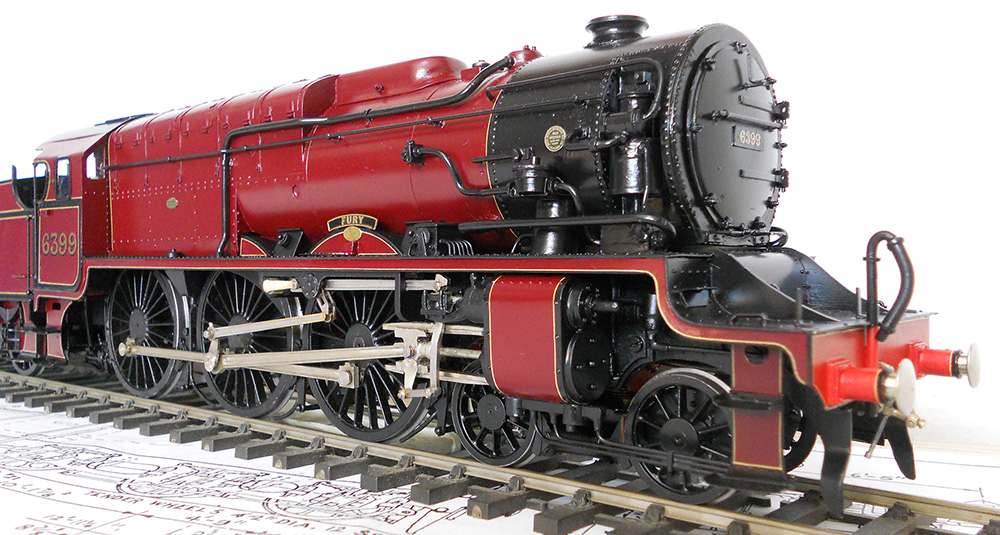
Bill Davis' model of FURY referred to in the text.
Site contents Copyright © LMS Society, 2026
July 31st, 2026
Site contents Copyright © LMS Society, 2026